Written by:
Pierce J.
Published:
November 6, 2026
Moving out of a building with a freight elevator? Here's when you need to reserve it, what to confirm with the building, and how to avoid a stalled move.
Yes, if your building has a freight or service elevator, you almost always need to reserve it before moving day, and you need to do it well before the week of the move. Most buildings with a dedicated freight elevator require written notice, a specific arrival window, and proof of insurance before they will let a moving crew use it, and skipping that step is one of the most common reasons a move stalls in the lobby.
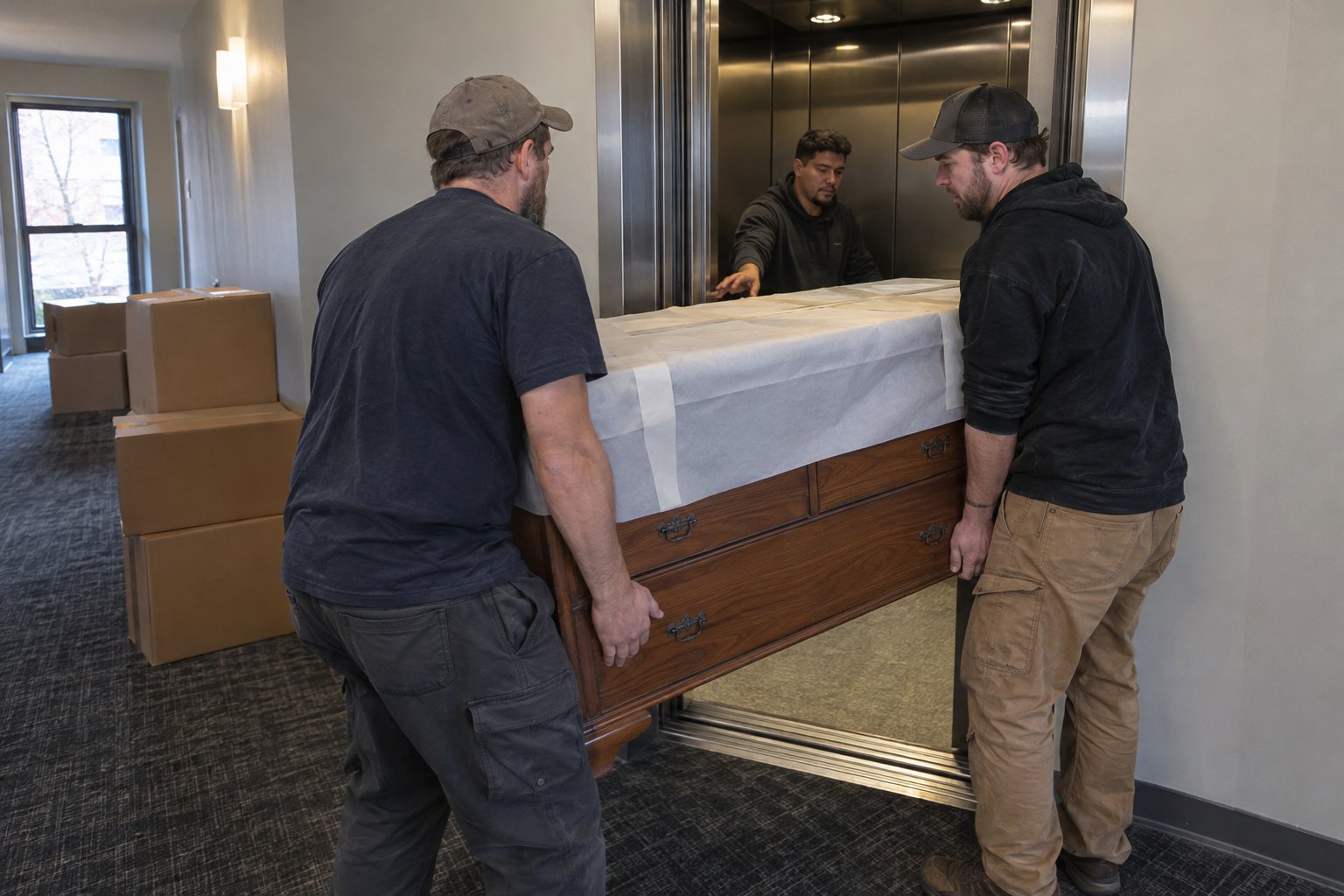
The passenger elevator in most mid-rise and high-rise buildings is off-limits for moving, both because of weight limits and because management does not want it tied up blocking hallways with furniture pads and dollies. The freight elevator exists specifically for this, but because every tenant in the building shares it, management controls access to it with a reservation system.
Most buildings ask for two to four weeks' notice, and some popular buildings fill their moving slots faster than that, especially around the first and last weekends of the month when turnover is highest. Call or email your building's management office as soon as you have a moving date, even before you've finalized every other detail of the move.
If you wait until the week of your move to ask, you may find every elevator slot already booked, which forces you to either push your move date or carry everything down a stairwell. Neither is a good position to be in on short notice. Treat the elevator reservation as one of the first calls you make, right alongside booking your moving crew.
Buildings typically require three things: a completed move-in or move-out form, a certificate of insurance (COI) naming the building and sometimes the management company as additional insured, and a specific date and time window for the move. Missing any one of these is the usual reason a reservation gets rejected or delayed.
The COI is the piece that catches people off guard, because it isn't something you can produce yourself. It has to come from your moving company's insurance carrier, and it often needs to list exact language the building requires, such as a specific additional-insured clause or a minimum liability amount. Ask your movers for a COI as soon as you know your building's requirements, not the day before, since some carriers take a few business days to issue one.
Some buildings also require a refundable deposit or ask for proof that your unit's doorways and hallways won't be damaged by requiring floor and wall protection, which movers typically bring on a job like this regardless.
The biggest misconception is that reserving the elevator reserves the whole day. In reality, most buildings give you a narrow window, often two to four hours, and once it's over the elevator goes back to general building use whether you're finished or not. People assume they can start whenever the crew arrives and work at a normal pace, then get caught mid-move when their window closes.
This matters because it changes how you plan the day. If your reserved window is three hours, your crew needs to know that going in, so they can prioritize getting the truck fully loaded or unloaded within that time rather than taking a more leisurely room-by-room approach. Tell your moving company the exact window as soon as you have it, not just the date, so they can staff and pace the job accordingly.
Confirm the exact elevator window, the loading dock or entrance you're allowed to use, any restrictions on moving blankets or pads touching elevator walls, and whether a doorman or building staff member needs to be present to operate the elevator or badge you into service areas. Buildings vary a lot on these details, and assuming your new building works the same way your old one did is a common mistake.
It's also worth confirming parking or loading zone access for the truck itself. Some buildings have a dedicated loading dock, others expect the truck to park on the street or in a designated loading zone for a limited time, and double-parking without a permit can get a truck ticketed or towed mid-move. Ask your building what's allowed, and if you're moving into or out of a building in Nashville, TN or another area with active street parking enforcement, this is worth confirming a few days ahead rather than discovering it on moving day.
If you run past your reserved window, most buildings require you to stop and either wait for a new slot or pay for an extension, if one is even available that day. Some buildings are flexible if no one else has the elevator booked right after you, but plenty will enforce the cutoff strictly, especially in buildings with back-to-back moves scheduled.
As a rule of thumb, book a window with some cushion rather than cutting it close. If you think your move will take three hours, a four-hour reservation gives you room for an elevator that's slower than expected, a delay getting the truck to the dock, or furniture that needs extra care getting around tight corners. It's easier to finish early than to ask a building for more time you didn't reserve.
The elevator reservation process itself doesn't change based on distance, but the stakes do. On a local move, a missed window usually means rescheduling with your crew for a return trip, which is inconvenient but recoverable. On a long-distance move, your moving crew and truck often have a tight multi-stop schedule, and a delay at the elevator can push back your pickup or delivery appointment with the rest of the route. If you're coordinating a long distance move in or out of a building with a freight elevator, confirm your reservation even earlier than usual and share the exact window with your movers in writing.
A freight elevator reservation is a small administrative step that can derail an entire move if it's skipped or left too late. Call your building as soon as you have a moving date, get the certificate of insurance request to your movers early, confirm the exact window and loading entrance, and build in a little extra time rather than cutting it close. If you're moving into or out of a newer high-rise or mid-rise building, expect a more formal reservation process, so give yourself extra lead time.
Planning your move? Request a quote from We Haul Nashville.
Your moving company's insurance carrier issues the certificate of insurance, not you or the building. Ask your movers for one as soon as you know the building's required wording and minimum coverage, since it can take a few business days to arrive.
Even if the building looks quiet, most management offices still require a reservation on file before granting elevator access, and staff may turn away a crew that shows up without one. It's worth confirming in writing rather than assuming an empty lobby means no reservation is needed.
Some smaller buildings without a dedicated freight elevator do allow limited passenger elevator use for moving, usually with furniture pads required and a shorter allowed window. Ask your building directly, since assuming this without confirmation can lead to a move that isn't allowed to proceed.
Give your crew the exact date, time window, loading entrance, and any building rules about padding or parking as soon as you have them. This lets the crew plan the pace of loading or unloading around the time limit instead of discovering it on arrival.
No, smaller walk-up buildings and many townhomes don't have a freight elevator system at all, so this step only applies to buildings that have one. Check with your specific building or management office rather than assuming based on building size alone.
Whether you’re moving a home, apartment, office, or just a few heavy items, We Haul Nashville is ready to help make the process easier.