Written by:
Pierce J.
Published:
July 19, 2026
Learn how to move a home workshop safely — from packing power tools and workbenches to transporting hazardous materials and reassembling your space at the new home.
Knowing how to move a home workshop is something most people do not think through carefully until they are standing in front of a cast-iron table saw that weighs three hundred pounds and has never left the corner it was assembled in, a pegboard wall holding dozens of hand tools arranged in a system that only makes sense to the person who built it, a workbench bolted to the floor studs, and a cabinet full of paints, solvents, and aerosols that cannot simply be thrown into a moving box. A home workshop looks like a straightforward equipment move on the surface — after all, it is just tools and storage. Get close enough to start packing it and the picture changes fast. Stationary power tools require disassembly and specialized handling, hazardous materials are regulated during transport, and the organizational systems built up over years of shop work are impossible to recreate from memory alone. Understanding how to move a home workshop means approaching it with a real plan before a single tool leaves the wall.
This guide walks you through how to move a home workshop from start to finish: how to audit your tools and equipment before you pack anything, how to handle hazardous materials responsibly, how to pack and protect hand tools, power tools, and stationary machines, how to disassemble and move large workbenches and shop furniture, and how to get your workshop set back up and functional at your new home without weeks of hunting for missing parts. Whether your workshop is a fully equipped garage with a table saw, band saw, drill press, lathe, and a wall of carefully organized hand tools, or a single workbench in a spare room with a tool chest and a handful of power tools, these steps will carry you through the move without the damage, disorganization, and frustration that workshop moves so often produce when they are not planned carefully.
Before you pull a single tool off the wall or wheel a single machine toward the door, spend real time evaluating everything in your workshop. A move is one of the best opportunities you will ever have to take honest stock of what you own — what is worth the effort of moving carefully, what has outlived its usefulness, and what is genuinely hazardous to transport. That evaluation shapes every decision that follows.
A workshop contains several distinct categories of items that require completely different packing approaches. Hand tools — chisels, planes, saws, clamps, squares, mallets — are dense, hard-edged, and capable of damaging themselves and everything around them if packed carelessly. Portable power tools — drills, sanders, jigsaws, routers, circular saws — are sensitive to impact and need their cases or purpose-built padding. Stationary power tools — table saws, band saws, drill presses, lathes, planers — are heavy machinery that must be disassembled, secured, and moved with equipment rated for the weight. Shop consumables and hardware — screws, nails, sandpaper, blades, lubricants — are easy to underestimate in volume and weight. And then there are the hazardous materials, which require their own category entirely and their own plan.
Tools accumulate in workshops the same way books accumulate on shelves — gradually, without intention, until there is more than anyone actually uses. A move is the right time to let go of duplicate tools, broken equipment you meant to fix but never did, and consumables that are so far past useful life that moving them would be wasteful. Donate usable tools in good condition to community tool libraries, vocational programs, or Habitat for Humanity ReStores. Discard anything that is genuinely unsafe or beyond repair. Every item you do not move is time, labor, and truck space saved.
Hazardous materials are the non-negotiable first priority in any workshop move, and they must be addressed before packing anything else. Most professional moving companies — including full-service movers — will not transport flammable, corrosive, or compressed materials. This is a legal and safety issue, not a preference. Planning for hazardous material disposal or transport on your own timeline, before moving day, eliminates one of the most common sources of last-minute chaos in workshop moves.
The list of common workshop materials that are prohibited from most moving trucks is longer than most people expect. Paints and stains, paint thinners and solvents, lacquers and varnishes, wood glues with flammable solvents, aerosol sprays, gasoline for small engines, propane and acetylene tanks, pool chemicals stored in the workshop, pesticides, and most lubricants in large quantities all fall into categories that most movers will not accept. Check with your specific moving company for their exact list — most publish it or will provide it on request.
Nashville and the surrounding area maintain household hazardous waste disposal programs that accept paints, solvents, fuels, and similar materials at no charge during designated collection events. Use these resources to properly dispose of anything you will not move yourself. For materials you genuinely need at the new home — a nearly-full can of a specialty finish, a partial tank of propane — transport them yourself in a personal vehicle with windows open, never stacked, and secured upright. Do not move hazardous materials in the moving truck under any circumstances.
Hand tools are deceptively difficult to pack well. They are heavy for their size, have sharp or fragile edges, and tend to scatter into complete disorganization the moment a box is opened carelessly. Packing them methodically is the single biggest factor in whether your workshop reassembles quickly or costs you days of searching and frustration.
If your hand tools are organized on a pegboard, shadow board, or wall rack, photograph the entire system in detail before removing a single item. Photograph close enough to identify individual tools and their positions. These images are your reassembly map at the new home. Without them, recreating a well-organized wall storage system from memory takes hours that a photo reference would reduce to minutes.
Chisels, plane blades, saw teeth, and router bits all need edge protection before they go into a box. Use dedicated blade guards when you have them. Wrap exposed edges in several layers of cardboard secured with tape, or use individual tool rolls and blade cases. Blades should never be loose in a box — they damage other tools, and they injure anyone who reaches in without full visibility. Organize wrapped hand tools in shallow, manageable boxes. A box of hand tools does not need to be large — it needs to be light enough to carry safely and organized enough to unpack without chaos.
Small hardware — screws, bolts, Allen keys, router bit sets, drill bit indexes — should travel in their original cases or containers whenever possible. For loose hardware without dedicated storage, use zip-lock bags labeled with a permanent marker, grouped by type or by the tool they belong to. Tape these bags to the inside lid of the box they travel in so they do not sink to the bottom and get separated from context.
Portable power tools — drills, circular saws, jigsaws, sanders, routers, oscillating tools — are durable in use but sensitive to the specific kinds of impacts and vibration that happen during a move. Taking thirty minutes to pack them correctly protects equipment that can represent thousands of dollars in replacement cost.
The original hard cases that come with most quality power tools are purpose-built to protect them during transport. Use them. If original cases are no longer available, pack each tool in a rigid cardboard box sized as close as possible to the tool's dimensions, lined with foam or bubble wrap on all six interior surfaces. Batteries should be removed from all cordless tools before packing and transported separately — lithium-ion batteries are a fire risk if damaged during transit. Battery chargers should be coiled and packed with their corresponding tool, clearly labeled.
Before packing any power tool, remove blades, bits, and any attached accessories. A circular saw blade left on a saw during transport is a safety hazard. A router bit left in a collet can damage the collet if the tool is dropped. Remove all cutting accessories, wrap them individually in cardboard, and pack them in a labeled bag stored alongside the tool. Do not pack loose blades in general boxes with other items.
Stationary power tools — table saws, band saws, jointers, planers, drill presses, lathes — are the most physically demanding challenge in a workshop move. They are heavy, often awkwardly shaped, and require real planning and appropriate equipment to move without injury or damage. This is the category where professional help pays for itself most clearly.
Before attempting to move any stationary power tool, locate the owner's manual — most are available online by model number if the paper copy is long gone — and review any manufacturer guidance on transport and relocation. Many stationary tools have specific procedures for locking or securing moving parts, removing fences and wings, and protecting precision-ground tables during transit. Following these procedures prevents damage that is expensive and sometimes irreversible.
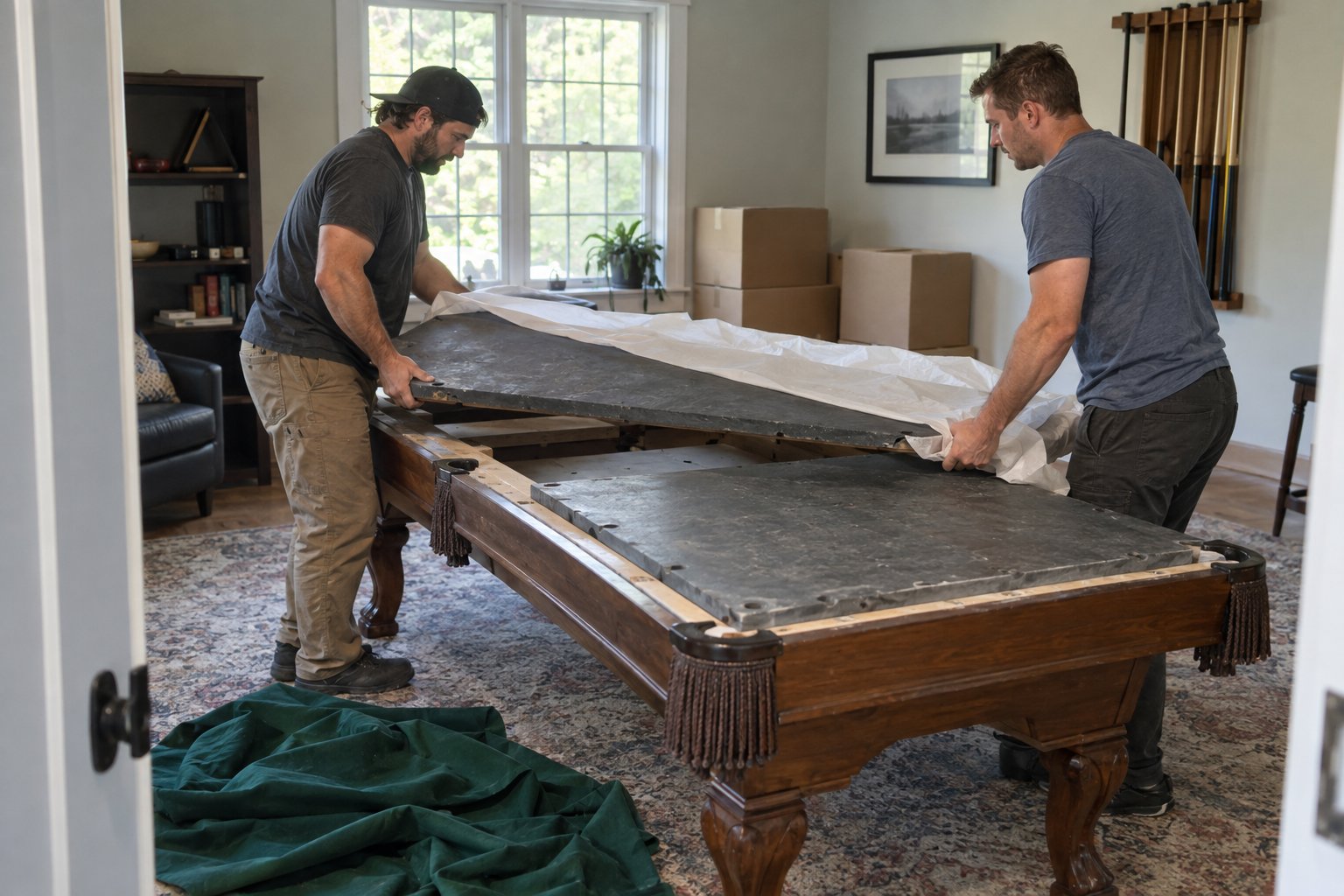
A cast-iron contractor table saw can weigh between two hundred and four hundred pounds. A large jointer or planer can approach the same. These machines require a heavy-duty appliance dolly, furniture sliders, and at minimum three or four people who know what they are doing. Attempting to move stationary machines with inadequate equipment or an insufficient crew is how people get injured and how machines get damaged. If you are not certain your crew and equipment are up to the specific machines in your shop, hire professionals with experience moving heavy equipment. It is not worth the risk.
The machined cast-iron tops of table saws, jointers, router tables, and band saws are precision surfaces that rust, scratch, and pit easily. Before moving, apply a coat of paste wax or a purpose-made tool surface protector to bare metal surfaces. Cover them with moving blankets secured with tape — not directly against the surface, but over a layer of cardboard or foam. In the truck, these machines must be secured so they cannot shift or tip. A stationary tool that tips during transport can damage itself, damage the truck floor, and create a dangerous situation for anything it contacts.
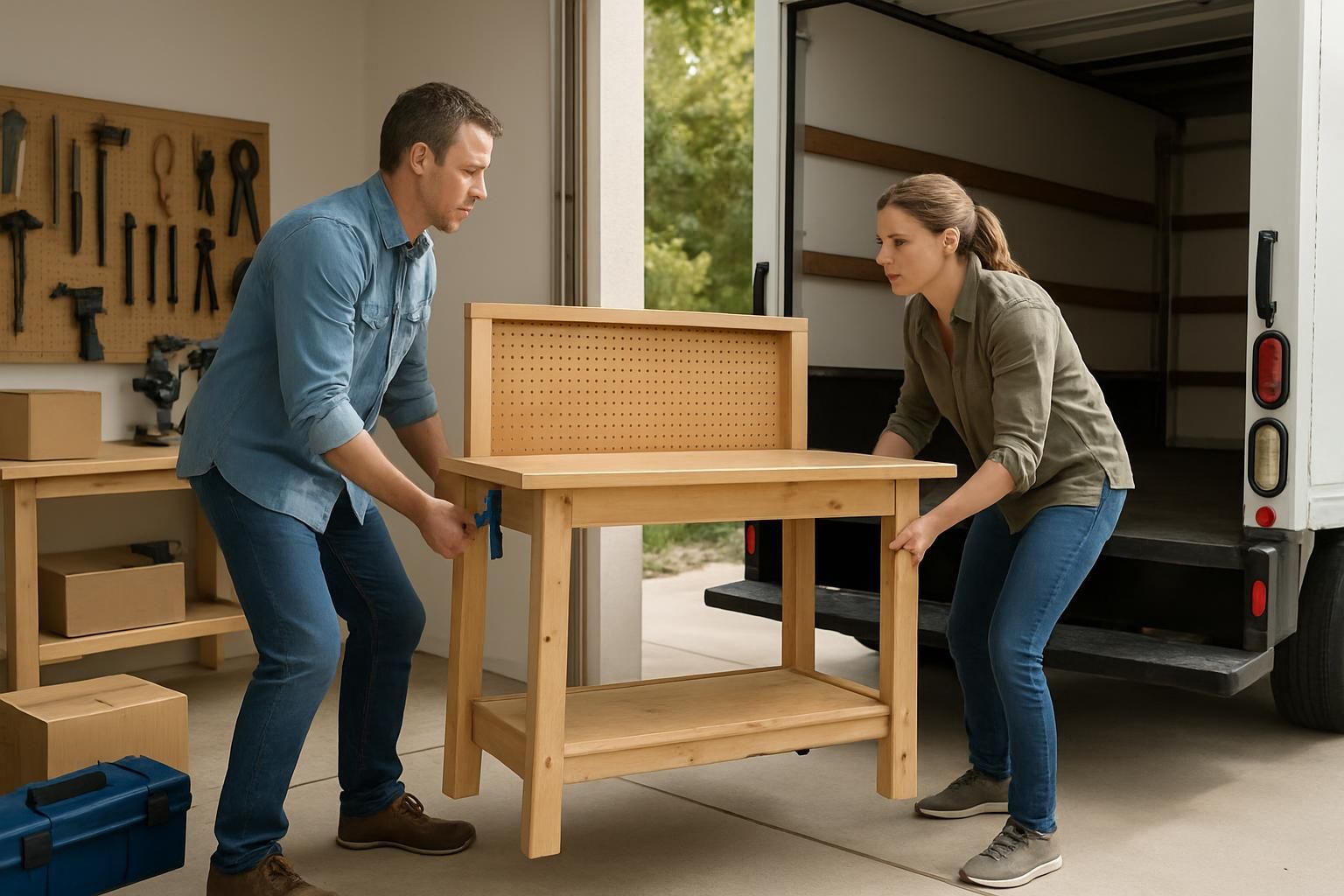
Workbenches, tool chests, shop storage cabinets, and assembly tables are the backbone of any workshop and among the most difficult pieces of furniture to move without disassembly. Most were assembled in place, often bolted to walls or floors, and were never designed to be relocated as a unit.
Before moving day, examine every piece of large shop furniture and determine what needs to come apart. Workbenches bolted to the wall must be unbolted and the hardware saved carefully — hardware removed during disassembly should be bagged and taped directly to the piece it came from so it is never separated. Rolling tool chests can often be moved intact on their own wheels with the drawers locked or secured with moving wrap, but they are extremely heavy when loaded and require a ramp or lift to get into a truck. Empty tool chests of all heavy contents before attempting to move them, and verify that drawer locks are engaged or drawers are secured with stretch wrap before rolling.
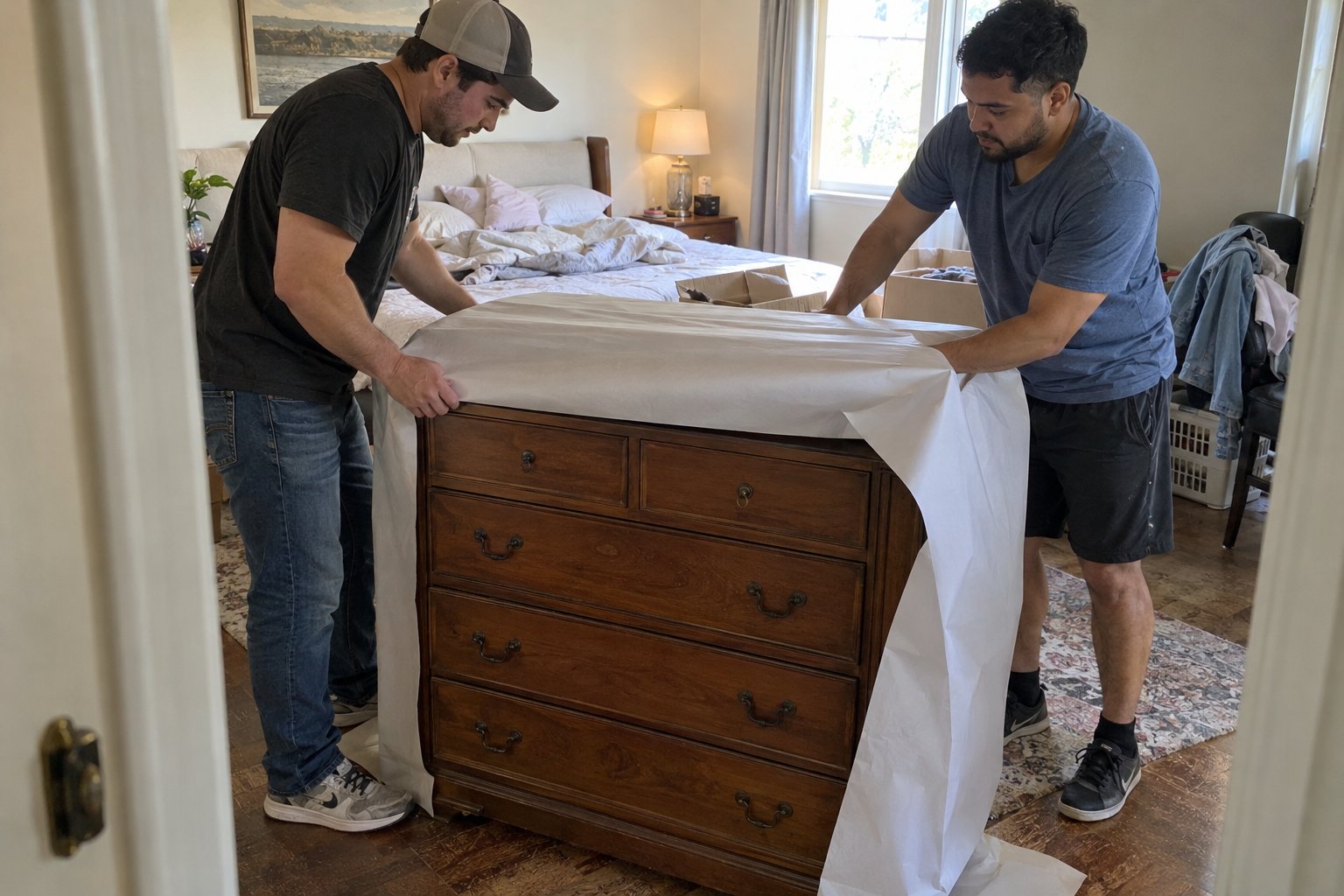
Many woodworkers have shop furniture with finished surfaces — veneered cabinets, laminate-topped benches, painted storage units. Wrap these in moving blankets before loading. Use cardboard corner protectors on any piece with sharp corners that could punch through a blanket and mark an adjacent piece. Flat-pack furniture that disassembles easily should be broken down completely, wrapped, and bundled for transport rather than carried as assembled units that can rack and break under their own weight.
The goal of every workshop move is not just to arrive with everything intact — it is to be back to work as quickly as possible. A thoughtful approach to setup at the new home pays back the time invested in careful packing within the first week.
Measure your new workshop space before moving day and sketch a layout for where major tools and furniture will go. Knowing where the table saw is going before it comes off the truck saves repositioning a three-hundred-pound machine multiple times. Consider workflow, electrical outlet locations, natural light, and dust collection routing when planning placement. Moving heavy stationary tools is difficult enough once — doing it twice because the layout was not thought through ahead of time is something every experienced woodworker will tell you to avoid.
Before running any stationary tool in the new workshop, verify that electrical connections are correct and that any dust collection system is properly reconnected. Stationary tools that require 240-volt circuits need to be confirmed at the correct voltage before being powered on. If your new workshop space requires any new electrical work — additional circuits, relocated outlets, 240-volt drops — schedule an electrician before moving day if at all possible so the shop is ready to use when the tools arrive.
A home workshop move is more complex than almost any other room in the house, but it is entirely manageable with the right preparation. The tools and equipment in a well-built workshop represent years of investment and even more years of work. They deserve a move plan that gets them to the new home in the same condition they left the old one.
Most professional moving companies — including full-service movers — will not transport flammable liquids, compressed gases, or other hazardous materials. This covers gasoline, paint thinner, lacquer, aerosol sprays, propane tanks, and most solvents common in home workshops. These restrictions exist for legal and safety reasons and are non-negotiable. Your plan should be to dispose of hazardous workshop materials through a local household hazardous waste program before moving day, or to transport small quantities of essential materials yourself in a personal vehicle with proper precautions. Never place flammable or hazardous materials in a moving truck.
Moving a stationary power tool like a table saw, jointer, or planer safely requires disassembly, appropriate equipment, and enough people. Start by consulting the manufacturer's manual for transport instructions — many machines have specific procedures for securing moving parts and protecting precision surfaces. Remove the fence, blade guard, and any detachable wings or extensions. Apply paste wax or a surface protector to bare cast-iron surfaces and cover them with cardboard and moving blankets. Use a heavy-duty appliance dolly rated for the machine's weight and have at least three to four people handling the move. If your crew or equipment is not sufficient for the specific machines in your shop, hire professionals with heavy equipment experience — the risk of injury and damage from attempting it underprepared is significant.
Yes — remove lithium-ion batteries from all cordless tools before packing them. Lithium-ion batteries can pose a fire risk if they are damaged during transit, and they add unnecessary weight to tool cases that may already be heavy. Pack batteries separately in a padded bag or case, away from metal objects that could cause a short. Keep batteries out of extreme heat during transit — do not leave them in a vehicle in direct sunlight for extended periods. Most battery manufacturers recommend storing lithium-ion batteries at partial charge for transport rather than fully charged or fully depleted.
The most effective strategy for maintaining workshop organization through a move is to photograph everything before you disassemble it. Photograph your pegboard, shadow board, or wall tool storage in detail before removing a single item — these images become your reassembly guide. Label every box clearly with both its contents and its destination location in the new shop. For hardware and small accessories, use labeled zip-lock bags taped to the inside lid of the box they travel in so they cannot sink and get separated. At the new home, unpack and place large stationary tools first according to your pre-planned layout, then workbenches and storage furniture, then hand tools and accessories last once the major infrastructure is in place.
Cast-iron table saw tops, jointer tables, band saw tables, and other machined surfaces need protection from rust, scratching, and impact during a move. Before moving, clean the surface and apply a coat of paste wax or a purpose-made cast-iron surface protector — this creates a barrier against moisture and minor abrasion. Cover the surface with a layer of cardboard or foam cut to size, then wrap the entire machine in moving blankets. Secure the blankets so they cannot slip and expose the surface during transport. In the truck, the machine must be strapped so it cannot shift or tip — movement during transit can cause exactly the kind of impact damage the blankets are meant to prevent.
Whether you’re moving a home, apartment, office, or just a few heavy items, We Haul Nashville is ready to help make the process easier.