Written by:
Pierce J.
Published:
October 6, 2026
Learn how to disassemble a pool table step by step, from removing rails and slate to packing felt, so nothing cracks, warps, or gets lost in the move.
Disassembling a pool table before a move means removing the pockets, rails, felt, and slate in that order, labeling every bolt, and handling the slate as three separate panels rather than one solid slab. Skip a step, and you risk a cracked slate panel, a torn cloth, or rails that never quite seat right again. It is a slower job than most people expect, usually two to four hours for a first-timer with a helper, and it is not a one-person task once the slate comes into play.
If you searched how to disassemble a pool table because yours is coming apart for a move rather than a repair, the good news is that the process is the same either way, and you do not need to be a billiards technician to do it correctly. You do need the right tools, a plan for where every piece goes, and realistic expectations about how heavy slate actually is. Here is the order that keeps the table, your floors, and your back intact.
You will need a socket wrench or ratchet set, a staple remover or flathead screwdriver, work gloves, furniture blankets, painter's tape, and a permanent marker. Have at least one other person on hand before you touch the slate.
Most pool tables are held together with hex bolts or lag screws under the rails, and a socket set covers nearly every table you will encounter. A staple remover makes felt removal far cleaner than prying with a screwdriver, which tends to gouge the wood underneath. Painter's tape and a marker sound minor, but labeling pieces as "rail, headboard, bolt set A" saves real time at reassembly, especially if the table sits in storage for a few weeks between homes.
Start by removing the pockets, then unbolt the rails from underneath the table, working corner to corner so the frame does not shift unevenly. Each rail typically has two to four bolts accessible from below.
Leather or molded pockets usually unstaple or unscrew from the underside of the rail. Set them aside with their hardware taped to the back. For the rails themselves, loosen bolts gradually rather than removing one side completely before starting the next, which keeps tension even across the frame. Lay each rail felt-side up on a blanket as you go so the cloth does not pick up scratches from the floor.
Pull the staples along the rail edges first, then work the felt free from the slate starting at a corner, lifting slowly rather than yanking. If the felt is stapled directly to the slate rather than glued, this step is quick and the cloth usually comes off reusable.
Glued felt is a different situation. If your table's cloth was glued down, expect it to tear or stretch during removal, and plan on new felt at the new location rather than fighting to save the original. Either way, roll or fold the felt loosely and never crease it sharply, since hard creases can leave permanent lines in the nap. If the table matters to you and the felt is in good shape, this is a reasonable point to call in a specialty mover rather than risk a cloth that cannot be replaced to match.
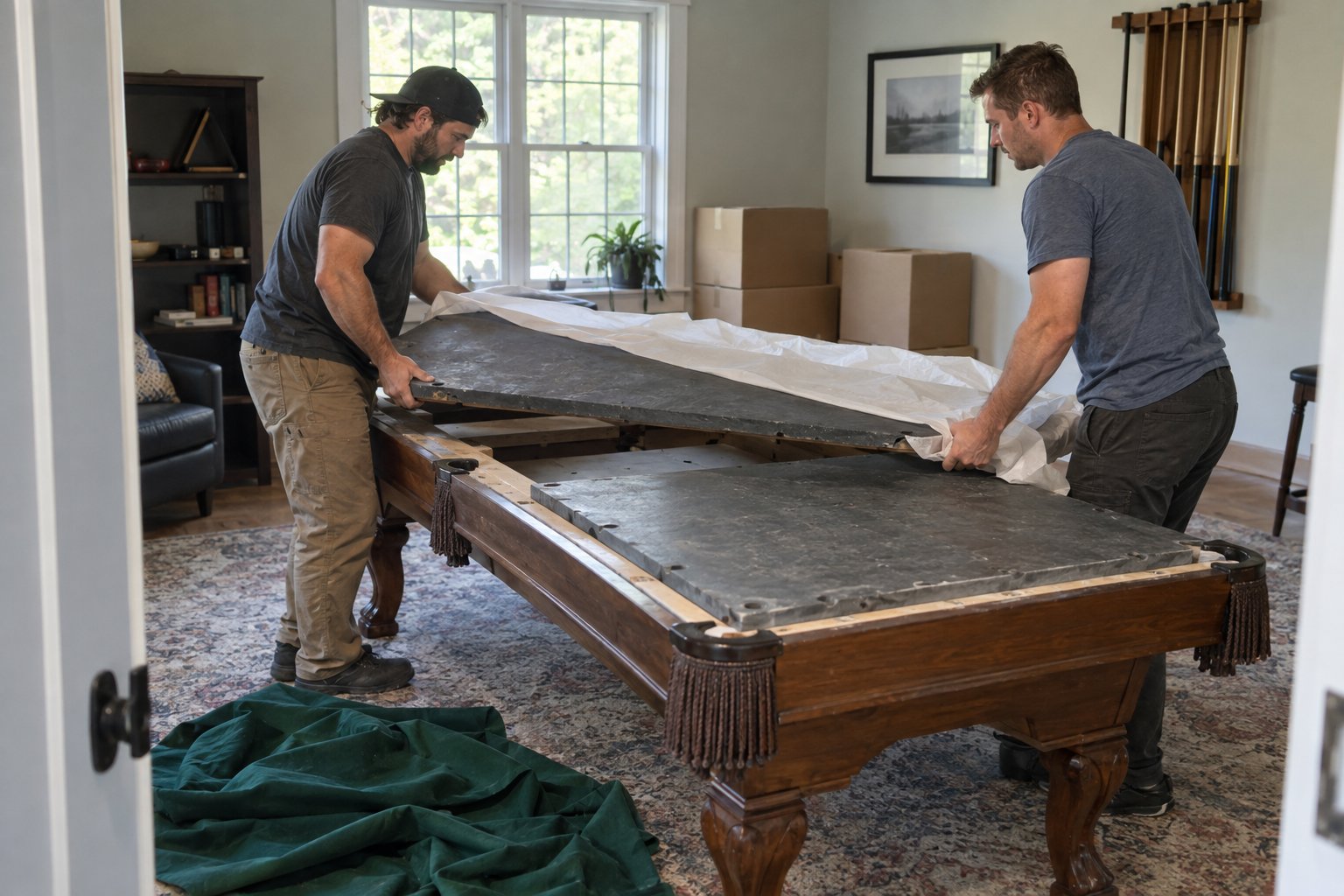
Most pool tables use three separate slate panels rather than one piece, and each panel still commonly weighs over 100 pounds. Unscrew each panel from the frame individually, and carry it flat with at least two people, never on an angle or on its edge.
Slate cracks under flex, not under straight weight, so the real danger is carrying it like a mattress or letting one end drop while the other is still supported. Keep it horizontal the entire time, from the table to the blanket to the truck. Wrap each panel individually in moving blankets and stand them on edge in the truck only if they are braced on both sides so they cannot shift or lean during transit. If your table has a single one-piece slate instead of three panels, which is common in older or lower-end tables, this is genuinely a job for extra hands or a professional crew, since one-piece slate can run several hundred pounds.
Hiring movers makes sense if your table has one-piece slate, if the felt is original and worth preserving, or if you simply do not have a second person available for two to four hours of lifting. A crew experienced with specialty items will also know how to true up the slate seams on reassembly, which is easy to get wrong and hard to notice until you are lining up a shot.
If you decide to handle the disassembly yourself but want help with the actual move and reassembly, a specialty item moving service can pick up where your prep work leaves off. This is also worth considering if your move is happening on a compressed schedule: our guide to moving on a tight timeline covers how to sequence heavy, multi-step jobs like this one against everything else on moving day.
Group hardware by rail in labeled bags, wrap each rail and the headboard in blankets, and keep slate panels separate from everything else in the truck so nothing stacks on top of them. Felt gets rolled, not folded, and stored somewhere it will not get crushed.
Load order matters here. Slate goes in first, braced upright against the truck wall with padding on both sides, followed by rails and pockets, with the felt and hardware bags riding on top where they cannot be crushed by heavier items. If you are unsure whether your vehicle or rented truck can handle the weight distribution safely, a labor-only crew can handle the loading and carrying while you supervise, which is often the more practical middle ground between full-service and solo DIY.
Reassembly reverses the process: slate goes in first and gets leveled before anything else is attached, then rails, then felt, then pockets. The leveling step is the one people skip and regret, since even a slight gap between slate panels throws off ball roll permanently.
Use a carpenter's level across all three slate panels before securing them, and shim as needed with the wax or leveling compound many tables ship with. Once the slate is flat and seamed tightly, the rest of the reassembly is mostly a matter of matching your labeled bolts back to their original spots.
Yes. Even individual slate panels commonly weigh over 100 pounds each, and they need to stay perfectly flat while being carried. One person lifting or tilting a panel risks a crack that cannot be repaired.
No, not safely. The felt has to come off to access the slate bolts underneath, and leaving it on during a move all but guarantees tears, stretching, or permanent creasing.
Most mid-range and higher-end tables use three slate panels, which is what makes solo handling realistic. Some older or budget tables use a single one-piece slate, which is significantly heavier and usually worth hiring help for.
Plan on two to four hours for a first-timer with a helper, longer if the felt is glued down or the hardware is rusted. Rushing the slate removal is where most damage happens.
Only if it was stapled rather than glued, and even then it depends on the condition of the cloth. Glued felt typically tears during removal and needs to be replaced at the new location.
Whether you’re moving a home, apartment, office, or just a few heavy items, We Haul Nashville is ready to help make the process easier.