
Written by:
Pierce J.
Published:
June 28, 2026
Learn how to move a piano safely — from uprights to grand pianos — with step-by-step prep, equipment, and pro tips for Nashville relocations.
Knowing how to move a piano is one of the most consequential pieces of knowledge in any relocation involving one — because a piano is not simply a large, heavy piece of furniture. It is a precision instrument with thousands of individual moving parts, a soundboard that can crack under improper stress, and legs that are never designed to bear lateral force. A piano that arrives at your new Nashville home out of tune is the best-case outcome of a poorly planned move. A piano with a broken leg, a cracked case, or a warped soundboard is a far more expensive problem — and sometimes an irreparable one.
This guide walks you through everything you need to know about how to move a piano safely: the equipment required, the techniques that differ between upright and grand pianos, how to navigate stairs and doorways, and when the move genuinely requires professional movers rather than willing friends with a pickup truck. Whether you are moving across Nashville or just across a room, treating this instrument with the care it requires is what gets it to the other side intact.
Pianos are not all the same, and the approach that works for one type will not work for another. Before you plan a single step of your move, identify exactly which type of piano you have — because the size, weight, center of gravity, and structural vulnerabilities are fundamentally different across piano categories.
Upright pianos — including spinets, consoles, studios, and full uprights — stand vertically with the strings running up and down inside a rectangular cabinet. They typically weigh between 300 and 800 pounds depending on the model and age, with older full-size uprights frequently landing at the heavier end of that range. Their center of gravity is relatively high and their base footprint is narrow, which means they tip more easily than their bulk suggests. The legs on an upright are decorative rather than structural load-bearers, so the cabinet must be supported from the bottom, never lifted or dragged by the legs.
Grand pianos — including baby grands, parlor grands, and concert grands — are a categorically different challenge. A baby grand typically starts around 500 pounds; a full concert grand can exceed 1,200 pounds. More importantly, the shape of a grand piano makes it nearly impossible to move in assembled form through most doorways. The standard approach is to remove the piano's lid, music desk, and pedal lyre, then lower the piano onto its side — with the flat side facing up — onto a specially designed piano board. This process requires trained hands: the legs must be removed in a specific sequence to prevent the piano body from tipping or falling during the transition.
Before moving day, know approximately how much your piano weighs. Check the manufacturer's specifications online if you have the brand and model number. Then walk the entire route from the piano's current location to the moving truck, noting every doorway width, every step, every stair landing, and any tight turns. Measure doorways with a tape measure. A piano board with a piano on it is not a forgiving object in a narrow hallway.
Moving a piano without the correct equipment is how injuries happen — both to the people moving it and to the instrument itself. The tools for piano moving are specialized, and substituting general moving equipment frequently fails under the weight and awkward geometry involved.
A standard furniture dolly is not appropriate for piano moving. A piano dolly is a heavy-duty platform on swivel casters, built to handle the concentrated weight of a piano at a low center of gravity. For grand pianos, a piano board — a flat, padded skid board with straps — is used to transport the piano on its side once the legs have been removed. These tools are available at professional moving supply houses or through piano movers who rent equipment. Do not substitute a standard appliance dolly or a basic hand truck.
Heavy-duty moving straps — ratchet straps, not bungee cords — are required to secure the piano to the dolly or board during transit. The piano must be immobilized: any shifting during transport, especially on a truck navigating Nashville's streets and highway ramps, puts enormous stress on the case and internal components. A piano skid board for grand pianos is padded to protect the finish and provide a stable surface for the instrument on its side.
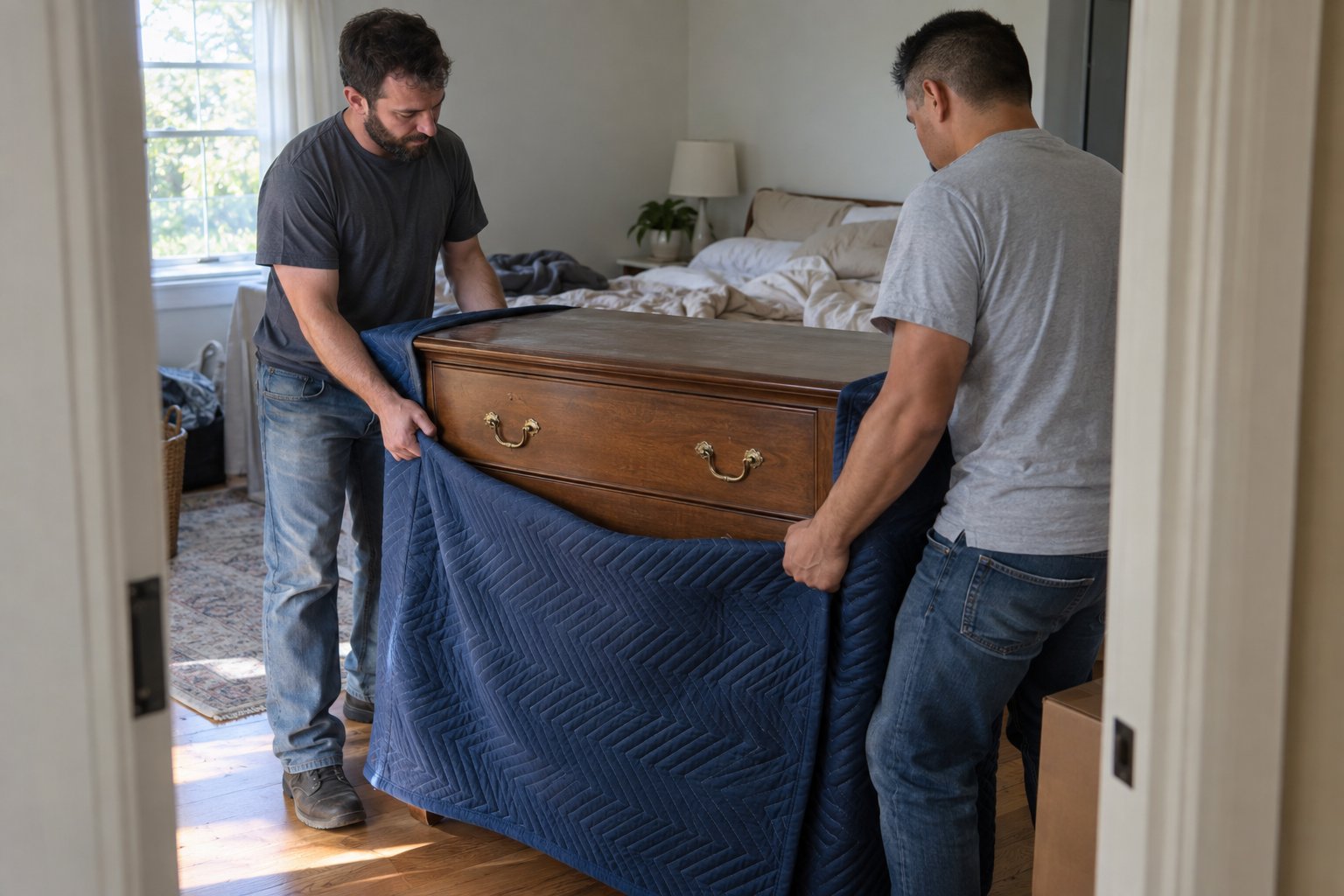
Wrap every exposed surface of the piano in thick moving blankets before the instrument contacts any dolly, strap, or wall. The finish on a piano — whether lacquered, polished ebony, or a satin wood veneer — scratches easily and repairs expensively. Pay extra attention to corners and edges, where blankets tend to slip during movement.
For an upright piano, plan on a minimum of three people: two to control the piano and one to manage the dolly and clear the path. For a grand piano, four to five people is a safer minimum given the complexity of tipping the instrument, removing legs, and loading it onto a board. Assign roles before you start — one person should be directing and calling movements so everyone acts in sync.
Moving an upright piano is physically demanding but manageable with the right team and equipment. Follow these steps in order and do not rush any stage.
Close and latch the keyboard lid. If your piano has a key cover lock, use it. Secure the piano's fallboard — the curved lid over the keys — so it cannot open during movement and expose or damage the keys. Wrap the entire piano in moving blankets, securing them with stretch wrap or packing tape applied only to the blanket surface, never directly to the piano's finish.
Tip the piano slightly backward while a second person slides the piano dolly underneath the base. The dolly should sit centered under the piano's weight. Once the piano is resting on the dolly, strap it securely — the piano should not be able to rock, shift, or tip. Test the stability before anyone lets go.
Move the piano through doorways keyboard-side first whenever possible, as this orientation typically offers the narrowest profile. On stairs, this is where professional movers earn their value. Moving a 500-pound upright up or down a full staircase requires a stair-climbing dolly, a controlled tipping technique, and experienced hands who know how to manage the descent without losing control. If your route involves more than two or three steps, strongly consider hiring professional piano movers for this portion of the move even if you handle the rest yourself.
Use a loading ramp rated for the piano's weight, not a standard aluminum ramp designed for boxes and lighter furniture. Position the piano against the truck's front wall — the cab wall — to minimize the distance it can travel if straps shift during transit. Strap the piano to the truck's wall anchors at both the top and base. The piano should not move at all when you push against it firmly.
Moving a grand piano is a multi-stage process that differs significantly from moving an upright. The instrument must be partially disassembled, carefully tipped onto its side, and transported on a piano board. This process is genuinely high-risk for an inexperienced crew and is one of the clearest cases where professional movers are the appropriate choice.
Start by removing the piano's prop stick and lid, then the music desk (the stand that holds sheet music), and finally the pedal lyre — the assembly beneath the keyboard that houses the three foot pedals. The pedal lyre is typically secured by one or two bolts accessed from underneath. Set all removed parts aside and wrap them separately in moving blankets.
Grand piano legs are removed in a specific sequence: typically the single leg on the treble side (the straight side of the piano) first, then both legs on the bass side together. The reason for this sequence is that once the treble leg is removed, two people can control the piano body while a third works on the bass legs — rather than having the piano unsupported. This step requires experienced coordination. Have the piano board positioned directly adjacent so the body can be lowered onto it immediately once the final legs come off.
With the treble leg removed and two people supporting the piano body, tip the piano slowly toward the bass side until it rests on its side on the padded piano board. The flat (straight) side of the piano faces up; the curved bass side faces down against the board. Strap the piano securely to the board and load it on the dolly. From this point, the process for navigating doorways and loading the truck is similar to an upright — move slowly, communicate every step, and protect every surface from contact with walls and door frames.
There is no shame in hiring professional piano movers — in fact, for many piano owners, it is simply the correct decision. The cost of professional piano moving is almost always less than the cost of repairing a damaged piano, and it is never more than the cost of a back or shoulder injury to a helper who underestimated the job.
Consider professional movers if your route involves a full staircase, if you have a grand piano of any size, if your piano is a vintage or particularly valuable instrument, or if you cannot assemble a team with genuine experience managing heavy awkward loads. A professional crew brings the right equipment, understands the mechanical vulnerabilities of the instrument, and carries the liability to cover damage if something goes wrong. For Nashville residents, a full-service moving company experienced with specialty items can handle a piano move as part of a broader relocation — or as a standalone job if the piano is the only piece requiring professional help.
The most expensive piano move is the one you attempt without the right people and then have to fix afterward. If there is any doubt in your mind about your team's ability to manage the instrument safely, make the call before moving day — not after.
Piano moving costs vary based on the type of piano, the distance of the move, and whether stairs are involved. A local upright piano move within Nashville typically ranges from a few hundred dollars for a straightforward ground-floor-to-ground-floor move to significantly more if stairs, long carries, or a grand piano disassembly are involved. Get at least two quotes from movers who specifically list piano moving as a service, and confirm whether tuning after the move is included or available at a discount — most pianos need to be re-tuned after relocation regardless of how carefully they are moved.
Yes. Nearly every piano requires tuning after a move, even a short local relocation. The vibration and movement of transit shifts string tension throughout the instrument, and changes in temperature and humidity between the origin and destination cause additional pitch drift. Most piano technicians recommend waiting two to four weeks after the move before scheduling a tuning — this allows the piano to acclimate to its new environment so the tuning holds better. If the piano has not been tuned in a long time, the technician may recommend a pitch correction session before a full tuning.
Two people is not recommended for moving an upright piano. A minimum of three people is safer — two to control the piano's movement and weight, and one to manage the dolly and clear the path ahead. On stairs or ramps, four people is a better minimum. The risk with two people is not just injury; it is loss of control of the piano during a turn or ramp transition, which can result in the piano tipping, the instrument sustaining significant damage, or someone being seriously hurt under the weight.
Wrap every exterior surface of the piano in thick moving blankets before any part of the piano contacts a dolly, strap, wall, or door frame. Secure the blankets with stretch wrap or packing tape applied only to the blanket itself — never apply tape directly to the piano's lacquer, veneer, or painted finish. Pay special attention to corners and the keyboard lid, which are the areas most likely to contact a door frame during tight turns. On the truck, keep the piano away from any metal anchor points or other furniture that could contact the wrapped surface during transit.
A standard moving truck is appropriate for piano transport provided the piano is properly secured. The critical factors are a loading ramp rated for the piano's weight, heavy-duty straps anchored to the truck's wall tie-down points, and positioning the piano against the front wall of the truck where it has the least room to shift. What makes piano transport unsafe in a standard truck is not the vehicle itself but insufficient strapping, placement that allows the piano to move during transit, or stacking other items against the piano in a way that transfers force to the case or legs.
Whether you’re moving a home, apartment, office, or just a few heavy items, We Haul Nashville is ready to help make the process easier.