Written by:
Pierce J.
Published:
August 18, 2026
Learn how to move houseplants without shock, breakage, or dead leaves. Prep, packing, and transport tips that keep pots and plants healthy on moving day.
Moving houseplants safely comes down to timing, temperature control, and giving roots and leaves room to breathe during transport. Most plants that die in a move were not killed by the drive itself, they were killed by sitting in a hot or freezing truck for hours, or by getting crushed under a box that shifted in transit. Handle the prep right and even a large plant collection can make it across town or across the state with minimal leaf drop.
Plants are not furniture, and they are not quite pets either. They cannot tell you they are stressed, but they will show you a week later with yellow leaves or a collapsed stem. If you are wondering how to move houseplants without losing half of them along the way, the answer starts days before the truck ever shows up.
Houseplants struggle during moves because they experience several stressors at once: temperature swings, low light, root disturbance, and physical jostling. Any one of these alone is usually survivable. Stacked together over several hours, they push a plant past its recovery point.
A moving truck is not climate controlled the way your living room is. In summer, the cargo area can climb well past what most tropical plants tolerate within an hour of sitting in the sun. In winter, even a short unheated ride can shock a plant that is used to indoor warmth. Add in low light for the entire trip and the physical vibration of the road, and you can see why plants that look fine on move day sometimes decline over the following two weeks.
Start preparing plants about a week out by checking for pests, pruning back anything leggy, and easing off watering slightly so the soil is not soggy on moving day. A plant that is dry-ish and pest-free travels far better than one that is waterlogged or hosting bugs that spread to the rest of your collection.
The best way to pack a plant is to secure the soil, protect the foliage, and keep the pot upright and stable, not to seal it in a sealed box like you would a lamp. Plants need airflow, so packing them like standard household goods will do more harm than good.
Cover the soil surface with a piece of plastic wrap or a damp paper towel held on with a rubber band to keep it from spilling during the ride. Place the pot inside an open or slotted box, or better yet, a sturdy nursery tray, so it cannot tip over. Small plants can share a box as long as they are wedged snugly enough that they will not knock into each other.
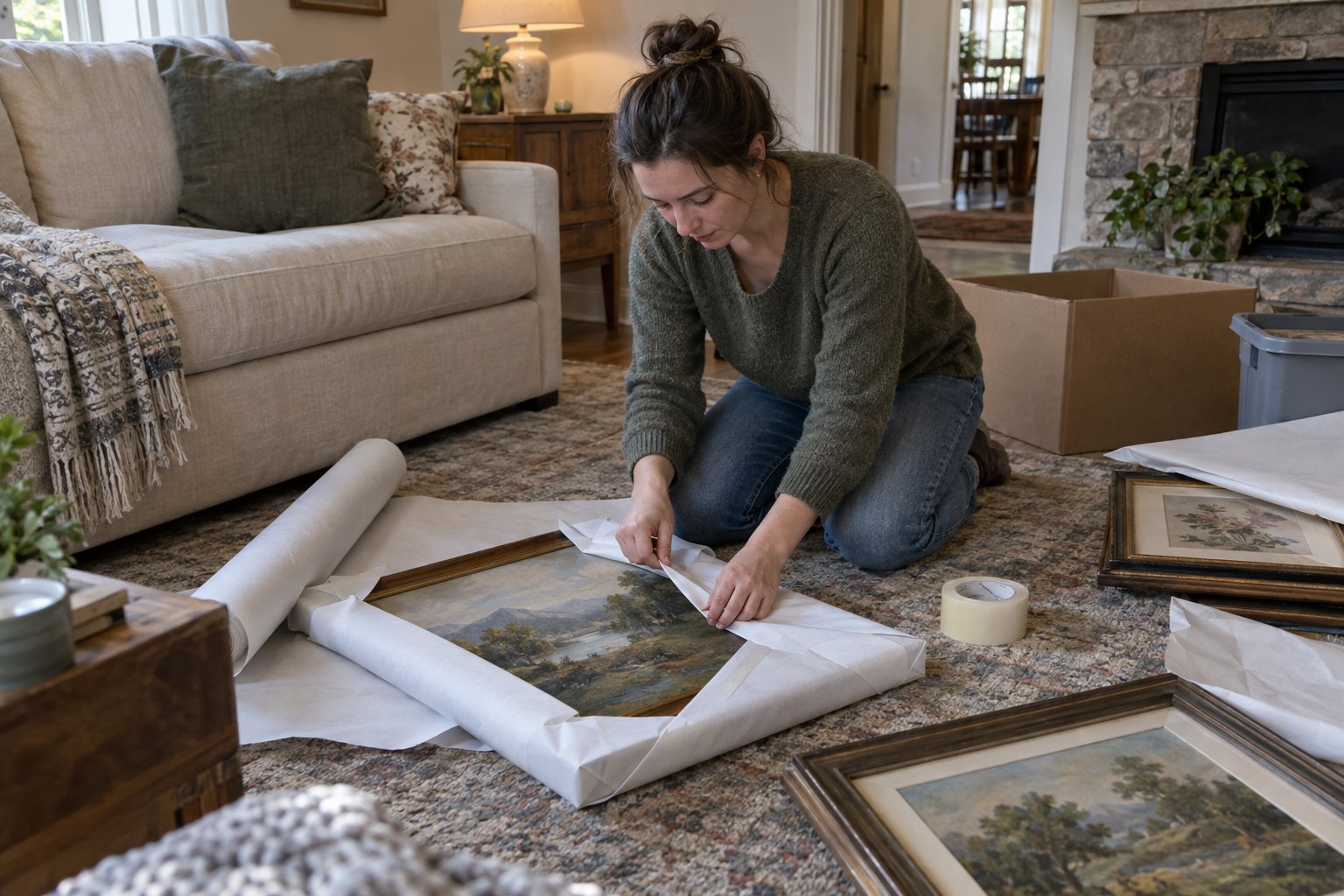
For tall or bushy plants, gently gather the foliage and wrap it loosely in breathable paper or a light sheet, similar to how you would handle a delicate item you are protecting from scratches. Avoid plastic bags directly against leaves, since trapped moisture and heat can cause them to wilt or rot faster than open air would. If you already have supplies set aside for cushioning breakables, the same instinct applies here, just swap tight plastic wrap for something looser.
Wrap cacti and other spiny plants in several layers of newspaper or an old towel before boxing them, both to protect your hands and to keep the spines from damaging nearby items. Leave the top uncovered so the plant still gets light and air during the trip.
In most cases, plants travel best in your own vehicle rather than on the moving truck, especially for anything temperature-sensitive or irreplaceable. Movers can certainly help load larger planters onto a truck for a local move, but a truck's cargo hold is rarely the ideal environment for anything alive, particularly over a longer haul.
If you are working with a full crew on a local move, ask ahead of time whether plants are something they will transport, since many moving companies treat them differently from standard furniture for insurance reasons. For a long-distance relocation, it almost always makes more sense to keep your plant collection with you in the car, where you can control temperature and check on them along the way. If you are coordinating a bigger relocation and want to know what movers will and will not take on the truck, it is worth confirming that during your initial moving quote conversation.
During transport, keep plants out of direct sun through the window, run the air conditioning or heat to match their comfort range, and avoid leaving them in a parked car for more than a few minutes. A car's interior heats up fast even on a mild day, and cold snaps can be just as damaging.
Position plants on the floor of the back seat or wedge them securely between other soft items so they cannot tip over during turns and stops. If your drive stretches beyond a few hours, plan a quick stop to check soil moisture and give any wilting leaves a light misting. Plants generally handle a bumpy short ride far better than they handle sitting in a hot car at a rest stop, so build your route around minimizing those parked windows rather than the driving itself.
As soon as you arrive, unbox plants first, before furniture and kitchen boxes, and place them in indirect light rather than full sun right away. A plant that has been in a dim box or car for hours needs a gradual reintroduction to bright light, not an immediate spot on a sunny windowsill.
Check soil moisture and water lightly if it has dried out, but resist the urge to overcompensate with heavy feeding or repotting in the first week. Plants generally do better with a period of stability after a move: same light, consistent watering, no fertilizer, no new pot, just time to adjust. If you notice some leaf drop or yellowing in the days that follow, that is a normal stress response for most houseplants and usually resolves within a few weeks as long as the new environment is reasonably stable.
Plants are one of several categories of belongings that need special handling rather than standard box-and-load treatment. If your home also includes glassware, artwork, or other breakables, it is worth reviewing how to pack fragile items for a move so your plants are not the only things getting extra care on moving day. And if you are still deciding whether to handle the move yourself or bring in a full crew, comparing a full-service move against a self-move can help you figure out where your time is best spent, especially if you have a large plant collection eating into your packing hours.
For households in the Nashville area with an extensive indoor garden or a few oversized planters that need careful handling, a local moving crew can help with the heavy lifting while you focus on the plants themselves.
It is risky. Overnight temperatures in an unheated or unairconditioned truck can drop or rise well outside what most houseplants tolerate, and darkness for that long adds stress on top of it. If an overnight stop is unavoidable, keep temperature-sensitive plants with you instead of on the truck.
No, water two to three days ahead instead of the morning of. Slightly moist soil travels better than freshly saturated soil, which is heavier and more likely to spill or create a soggy mess in the box.
Use a furniture dolly to move large planters rather than lifting them, and wrap the pot itself in a moving blanket to prevent cracks. If the plant is too large to fit safely in a car, ask your moving crew ahead of time whether they can transport it upright on the truck for short local trips.
Some mild shock, shown as yellowing or a few dropped leaves, is common and usually temporary. Keep light, watering, and temperature as stable as possible for the first couple of weeks rather than making other changes, and most plants recover on their own.
It is possible but riskier than driving them yourself, since shipping adds days in a dark box with no temperature control. If a long-distance move makes personal transport impractical, consider rehoming particularly delicate plants and starting fresh with new ones at your destination.
Whether you’re moving a home, apartment, office, or just a few heavy items, We Haul Nashville is ready to help make the process easier.